
How to use it
It takes about twenty seconds and there is no daily routine to keep up.
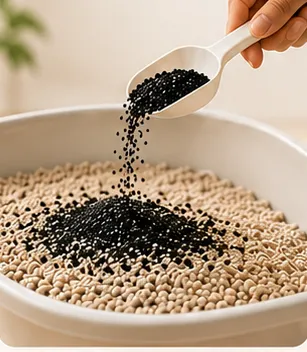
Sprinkle
About three tablespoons across a standard 2.5-litre tray. Start with fresh litter the first time.
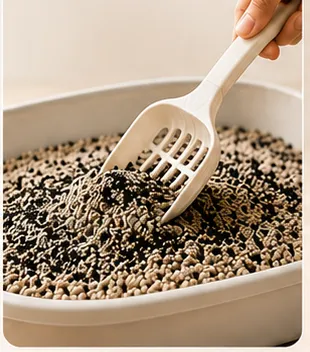
Mix it through
Turn it over with the scoop until the black granules disappear into the litter rather than sitting on top.
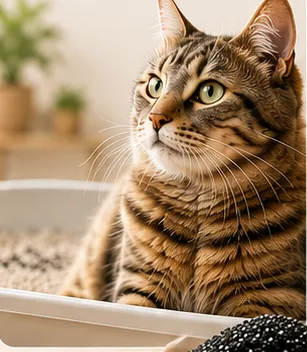
Leave it alone
No daily top-up. Add more when you next change the litter completely.
How much to use
Three tablespoons — roughly 25 grams — is the right amount for a standard open tray holding about 2.5 litres of litter. The sizing is proportional, so scale it with the tray rather than with the cat:
- Standard open tray (2.5 L): three tablespoons.
- Large or high-sided tray (5 L): five to six tablespoons.
- Covered or hooded tray: the same as an open tray of the same volume. A hood concentrates odour rather than creating more of it.
- Two cats sharing one tray: keep the dose the same but expect to refresh it sooner — the carbon fills up at roughly double the rate.
Using more than the guide amount is not harmful and will not damage anything. It is simply uneconomic, since carbon only adsorbs what reaches it.
Start with clean litter
The one instruction worth following precisely. If you add carbon to a tray that has already been in use for a week, the first thing it does is adsorb the odour that is already there — which uses up a good part of its capacity before your cat has used the tray again.
Empty the tray, wash it if it needs it, fill with fresh litter, then add the carbon. From that point on you are working with the full capacity.
Which litters it works with
All of them. The carbon acts on odour in the air inside the tray, so what the litter underneath is made of does not change the mechanism — clay, silica crystal, wood pellet, paper, corn and tofu litters all behave the same way from the carbon's point of view.
It will not interfere with clumping. The granules are coarse rather than powdered, so they sit between litter particles instead of coating them, and a clumping litter continues to clump normally. You will see black specks in the clumps you scoop out; that is expected.
If the smell comes back
That is saturation, not failure — the pores are full. Change the litter completely and add fresh granules. If it is happening noticeably faster than the life of a tray of litter, the usual causes are a tray being shared by more cats than it was dosed for, a tray that is scooped infrequently, or a hooded tray in a small unventilated room.
One cause worth ruling out: if the smell is coming from outside the tray — a soiled patch of carpet or a cat spraying — no litter additive will reach it, and the problem needs solving at the source.
Safety
The product is coconut-shell activated carbon and nothing else. It is inert, which is to say it does not react with anything, and a cat that ingests a small amount while grooming passes it through unchanged. Activated carbon is routinely given to animals in veterinary medicine for precisely this reason — it is not absorbed by the body.
It is not dusty, so it does not present a respiratory irritation in the way powdered additives can. There is no fragrance, no solvent and no propellant.
Common sense still applies: this is a household product, not food. Keep the pouch closed and out of reach of children, and if a large quantity is swallowed by a pet or a person, contact a vet or a doctor as you would with any non-food item.