
How activated carbon removes litter odour
The mechanism is physical, not chemical — and understanding it is the difference between buying something that works and buying perfume.
Where the smell actually comes from
Cat urine smells for two reasons, and they arrive on different timetables. The first is ammonia: bacteria in the tray break urea down within hours, and ammonia is light enough to leave the litter and reach you across a room. The second is a group of sulphur compounds called thiols, which come from a protein unique to cats called felinine. Thiols are what give an unneutered tom's spray its particular carrying power.
Both are gases. That matters, because it means the smell is not sitting in the litter waiting to be covered up — it is leaving the litter continuously and travelling. Anything that works has to catch those molecules in the air, at the tray, before they disperse.
What activated carbon is
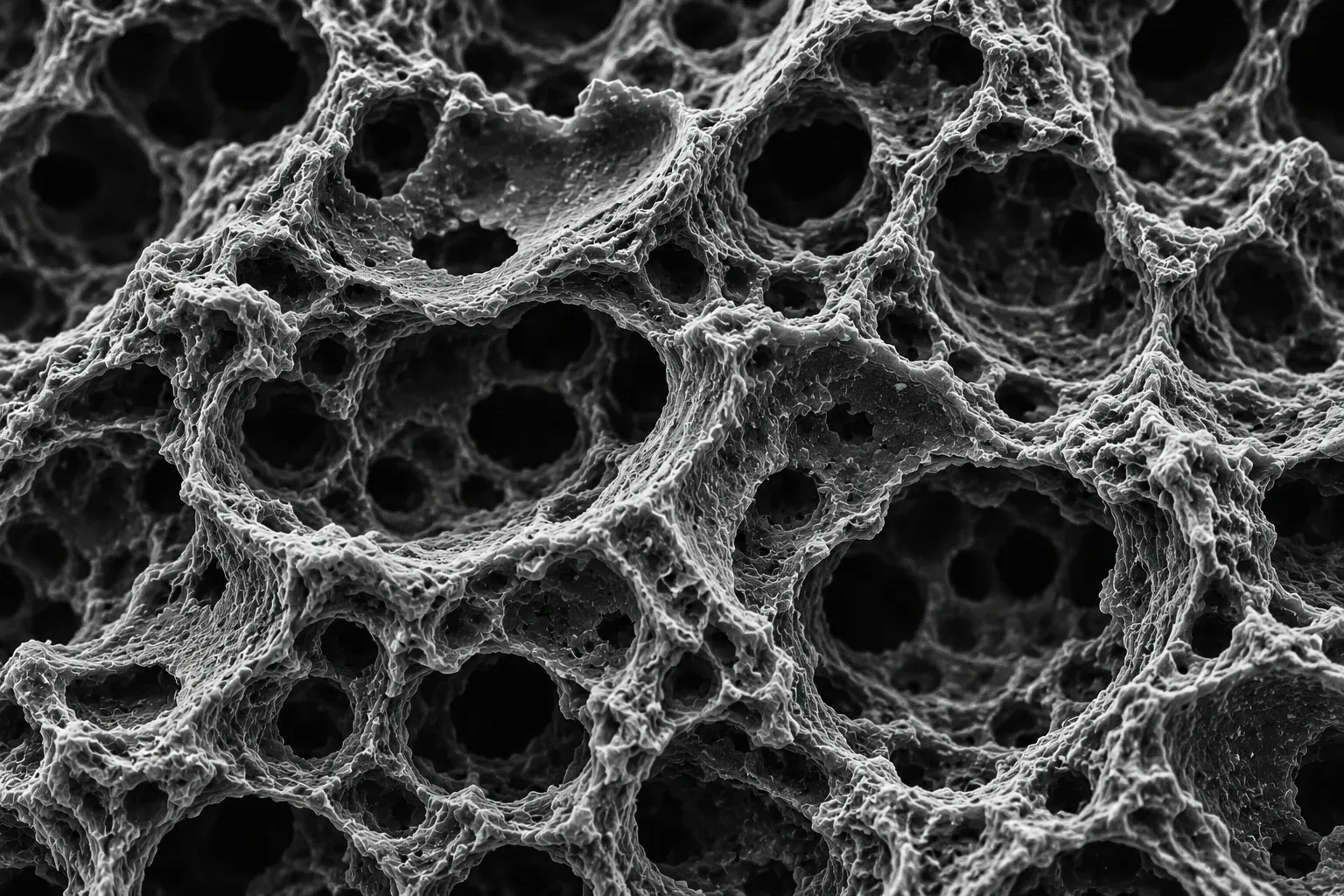
Start with coconut shell, which is unusually dense and hard. Heat it without oxygen until everything but the carbon skeleton burns off, then treat that skeleton with steam at around 900 °C. The steam etches channels through the structure, opening an enormous network of pores.
The result is a material that is mostly empty space. A single gram carries something in the region of a thousand square metres of internal surface — comfortably more than a tennis court, folded into a granule you could lose between your fingers. Coconut shell is prized for this because its pores come out small and numerous, which is exactly the size range that suits small gas molecules like ammonia.
Adsorption, not absorption
The two words get used interchangeably and they describe different things.Absorption is a sponge taking up water: the liquid goes into the body of the material and fills it. Adsorption is a molecule sticking to a surface and staying there, held by weak intermolecular attraction.
Activated carbon adsorbs. An ammonia molecule wandering into a pore is attracted to the carbon wall and adheres to it. Nothing dissolves, nothing reacts, no new compound is created. The molecule is simply held on a surface and is no longer in the air.
This is why the effect does not reverse when the tray warms up in a sunny hallway, and why there is no point at which the carbon starts giving the smell back. It is also why the same material is used in water treatment, air purifiers, and in hospitals to treat certain poisonings — the mechanism is well understood and old.
How it compares
Scented granules and sprays
These add a fragrance alongside the odour rather than removing anything. In a small room you end up smelling both. There is a second cost: a cat's sense of smell is roughly fourteen times more acute than a human's, and a tray that has been perfumed to a level you find pleasant can be overwhelming to the animal using it. Tray avoidance after a change of litter product is a common complaint on veterinary forums.
Bicarbonate of soda
Bicarbonate genuinely does something — it neutralises acids chemically. The difficulty is that the worst-smelling compounds in a litter tray are not acidic. Ammonia is alkaline, so bicarbonate has no useful reaction with it at all. Bicarbonate is also a fine powder, and fine powder in a litter tray becomes dust in the air when the cat digs.
Enzyme and bacterial products
These introduce live cultures that digest waste compounds. They can work well, but they need moisture, a workable temperature and time — typically hours — and they are living products with a shelf life and storage conditions. Carbon has no shelf life, needs no conditions, and acts the moment a molecule reaches it.
When it stops working
Adsorption is not infinite. Every pore that holds a molecule is a pore that cannot hold another, and when the internal surface is occupied the granule has done its work. You will not get a warning — the smell simply returns gradually.
For one cat and a standard tray, that point usually coincides with the litter needing a full change anyway, so the practical answer is to add fresh carbon each time you change the litter rather than trying to judge saturation. With two cats sharing a tray, expect to reach it sooner.
A note on what we can and cannot evidence. The chemistry above is standard, published material science, not a claim specific to us. What we have not done is commission independent laboratory testing of this particular product against named competitors, so you will not find percentage figures or performance graphs on this site. When we have that testing, we will publish it.