
Is activated carbon safe for cats?
A reasonable question, because whatever goes in the tray eventually goes on the paws, and from the paws into the cat.
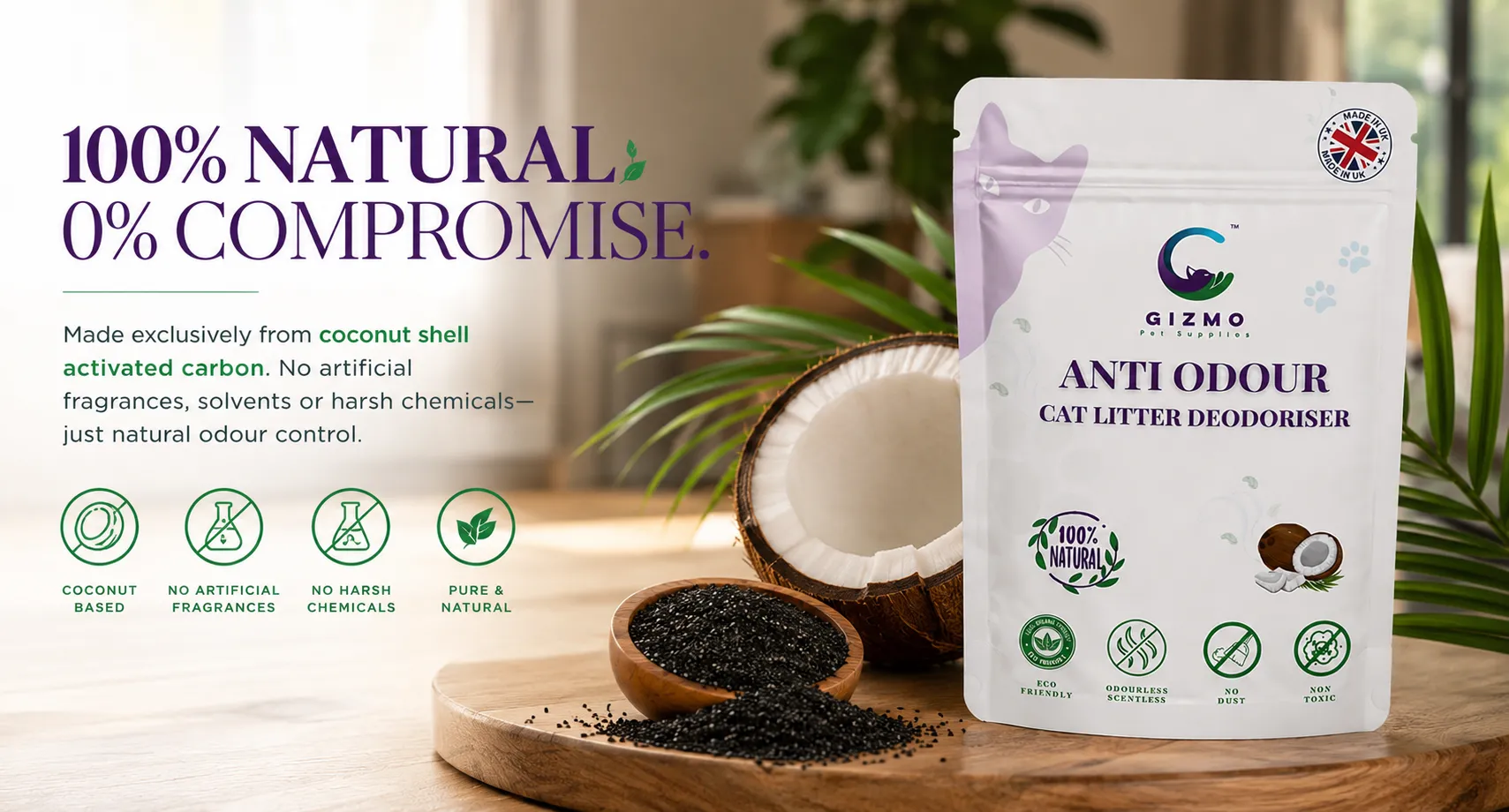
Cats groom. Anything you put in the litter will be walked through and then licked off, in small quantities, every day. That makes “is it safe” a more serious question for litter additives than for most household products, and it is worth answering properly rather than with a reassuring adjective.
What activated carbon is
Carbon — the element — processed so that its structure is full of pores. For the coconut-shell kind, that means shell heated without oxygen until only the carbon skeleton remains, then treated with steam at around 900 °C to open the pore network. Nothing is added. There is no binder, no solvent and no coating.
The result is chemically inert. It does not react with water, stomach acid, or the tissues of the body.
Why that matters
Because inert means it passes through. Activated carbon is not absorbed across the gut wall, so it does not enter the bloodstream and cannot accumulate in organs. Whatever is swallowed comes out again.
This is not a marketing claim; it is the basis of a standard veterinary treatment. Activated charcoal is given to dogs and cats that have eaten something toxic, precisely because it travels through the digestive tract binding the poison to its surface and carries it out. Vets administer it in doses measured in grams per kilogram of body weight — vastly more than a cat could pick up from grooming — and the reason it is safe to do so is that the carbon itself does nothing.
The realistic exposure from a litter additive
A cat walking through treated litter picks up granules on the pads and between the toes, and ingests a fraction of that while grooming. We are talking about milligrams, intermittently, against a therapeutic dose of several grams given deliberately.
The practical risks are not toxicity. They are:
Dust. Fine powdered additives can be inhaled and irritate airways, particularly in cats with asthma — which is not rare. This is an argument for granular products over powders generally, including over bicarbonate of soda, and it applies regardless of what the material is.
Large quantities. A cat that eats a significant amount of anything non-food can get an obstruction. This is a general rule about bags of household product left open, not something specific to carbon.
Pica. A cat that deliberately eats litter is showing a symptom — often anaemia or a dietary deficiency — and needs a vet rather than a different litter product.
What to check on any litter additive
Read the actual composition, not the front of the bag:
- Single ingredient or a list? Coconut-shell activated carbon should be exactly that. If there is a fragrance, a “freshness agent” or an unspecified blend, you no longer know what the cat is grooming off.
- Granular or powdered? Granules sit between litter particles. Powder coats them and becomes airborne.
- Scented or unscented? Fragrance is the component most likely to cause a problem, both as an irritant and as a reason for the cat to stop using the tray.
- Chemically activated or steam activated? Some activated carbons are produced using phosphoric acid or zinc chloride rather than steam. Properly washed, the finished product is still inert, but steam activation avoids the question entirely.
Honest limits of what we can tell you
Our own product is coconut-shell carbon, steam activated, unscented, granular and single-ingredient. The safety reasoning above is about the material, and it is drawn from how the material behaves and how veterinary medicine uses it — not from testing we have commissioned.
We have not run feeding trials, we do not hold a veterinary certification, and you will not find a safety seal on our packaging, because we have not earned one. What we can tell you is exactly what is in the bag, which is one thing.
If your cat has a respiratory condition, is pregnant, is a kitten, or has a history of eating non-food items, ask your vet before changing anything about the tray — including this.