
How to stop your cat's litter tray smelling
Most advice on this starts with the product you should buy. Start with the tray instead — several of the fixes below cost nothing.
A litter tray that smells is not a sign you are doing something wrong. It is a container of urine and faeces in a warm house. The question is only how much of it reaches the rest of the room, and that turns out to be very controllable.
Work through these roughly in order. The first four are free.
1. Scoop twice a day, not once
This is the single biggest lever and most people under-do it. Urine clumps begin producing ammonia within a few hours as bacteria break urea down, and the smell climbs steeply after that. Scooping morning and evening removes most waste before it reaches its smelliest phase.
If twice a day is not realistic, once a day at a consistent time still beats an unpredictable schedule, because the tray never gets more than 24 hours of build-up.
2. Check you have enough trays
The rule of thumb among behaviourists is one tray per cat plus one spare. Two cats sharing a single tray produce twice the waste in the same volume of litter, which means roughly half the time before it smells — and it also raises the chance one of them starts going elsewhere.
If you have the space, an extra tray is cheaper than any product on this list.
3. Use more litter than you think
A shallow layer cannot absorb a full urination, so liquid reaches the plastic and sits there. Aim for 7–10 cm of depth. It costs more litter per change, but it extends the time between full changes and keeps the base of the tray dry, which is where stubborn smells get established.
4. Move the tray out of a dead corner
Odour is a gas. In a cupboard, a tiny bathroom or a windowless utility space it concentrates and then rolls out at you when you open the door. A spot with some passive airflow, away from radiators and direct sun, makes a noticeable difference — heat accelerates both bacterial activity and evaporation.
Do not move it next to the food bowls to solve this. Cats generally will not use a tray beside where they eat.
5. Wash the tray properly, and watch what you wash it with
Plastic scratches, and scratches hold residue. Every full litter change, wash the tray with warm water and unscented washing-up liquid, and replace the tray itself every year or two once the surface is visibly scored.
Avoid anything containing ammonia — it smells like urine to a cat and can encourage them to mark the spot. Also avoid bleach for the same practical reason, plus the obvious safety one, and never use phenol-based disinfectants (the ones that go cloudy in water, like some pine cleaners); phenols are toxic to cats.
6. Reconsider a hooded tray
Hoods are sold as odour control and they do stop smell escaping — into the room. Inside the hood, the air stays saturated, which is unpleasant for the cat and means the tray feels worse every time you open it. Some cats start avoiding hooded trays for exactly this reason.
If you keep the hood, the scooping discipline above matters more, not less.
7. Add activated carbon
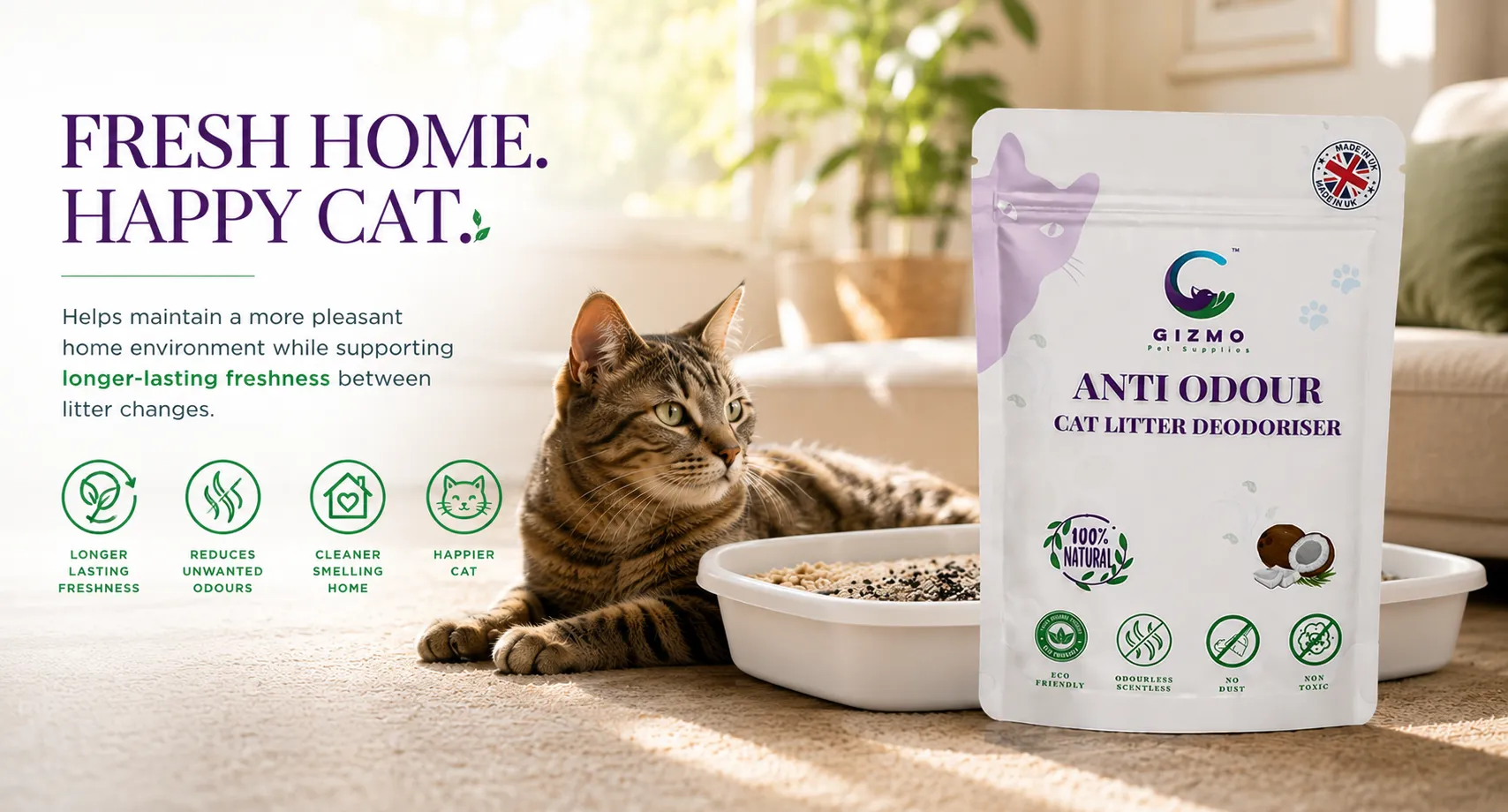
This is where a product earns its place. Coconut-shell activated carbon adsorbs odour molecules out of the air in the tray — the ammonia and the sulphur compounds both — and holds them inside its pore structure. It is unscented, adds nothing to the litter, and does not interfere with clumping.
It is not a substitute for scooping. It buys you the gap between scoops, and it extends how long a tray of litter stays tolerable before a full change.
8. Skip the scented products
Scented litters, perfumed granules and plug-in air fresheners add a smell on top of the smell. In a small room you end up with both, and the combination is often worse than the original. A cat’s nose is roughly fourteen times more sensitive than ours, so a fragrance level you find pleasant can be overwhelming at tray height.
Bicarbonate of soda is better than perfume but still limited: it works on acids, and ammonia is alkaline, so it does little against the main offender. It is also a fine powder, which becomes airborne dust when the cat digs.
9. If none of it works, see a vet
A tray that suddenly smells much stronger, or urine that smells unusually sharp, can indicate a urinary tract infection, kidney problems or diabetes — all of which change urine composition. So can a cat drinking noticeably more or less than usual.
If the smell changed suddenly rather than gradually, treat that as a health signal rather than a housekeeping problem.
The short version
Scoop twice daily, use enough litter in enough trays, put them somewhere with air, wash with unscented soap, and add activated carbon for the gap in between. Do not buy fragrance. If something changes suddenly, ask a vet.