
Clumping or non-clumping litter?
The clumping one is usually right, but not always — and the reasons it is wrong are specific.
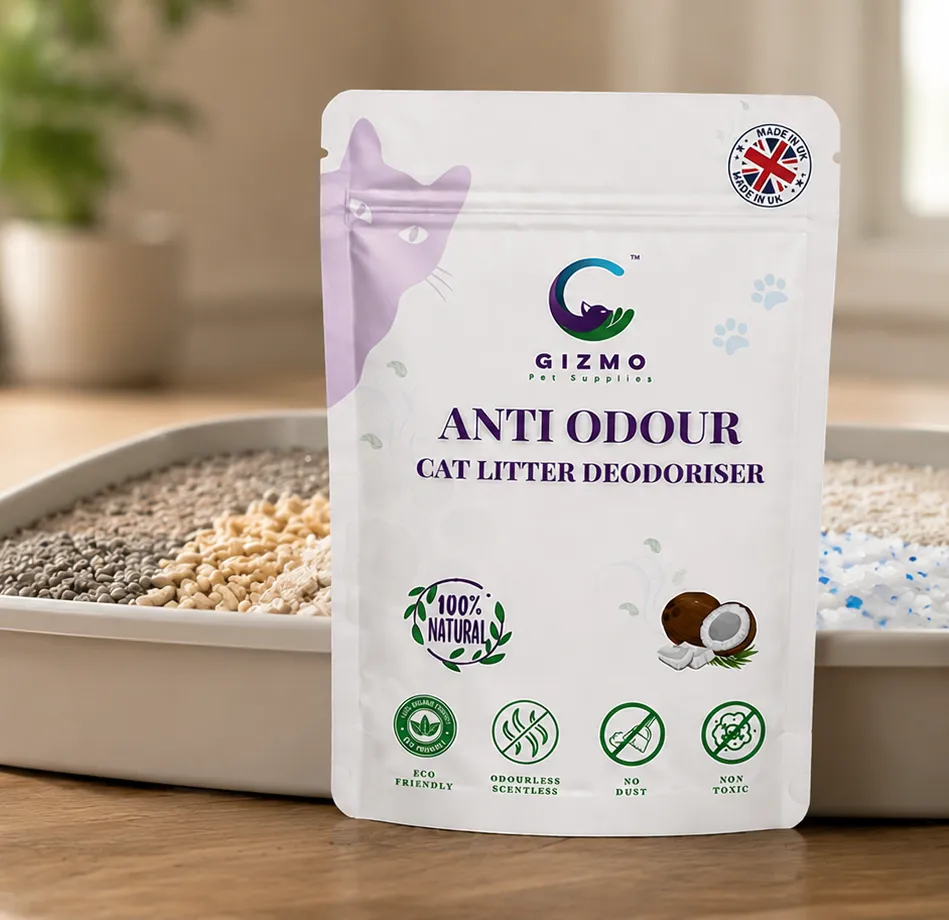
Both do the same job and the difference is entirely in what happens to urine once it lands.
Clumping litter is usually sodium bentonite, a clay that swells on contact with liquid and binds into a solid mass. The urine stays in that mass and you lift the whole thing out.
Non-clumping litter absorbs urine into the bed and lets it spread. Nothing solidifies, so there is nothing to scoop except solids. It is usually plain clay, sometimes with crystals mixed in.
Everything else follows from that.
Odour
Clumping wins, and not narrowly.
Removing a clump removes the urine before bacteria finish converting it to ammonia. With non-clumping, the urine stays in the tray for days spreading through the bed, and the whole tray becomes the smell. You can scoop solids out diligently and the tray will still turn.
This is the main reason most people end up on clumping litter.
Cost over a year
Non-clumping looks cheaper per bag and usually is not cheaper per year.
A clumping tray gets topped up as clumps come out and changed fully every few weeks. A non-clumping tray has to be emptied completely roughly twice a week, because there is no way to remove just the soiled part. Over a year the non-clumping tray usually gets through more litter, and you spend more time on it.
The exception is a household with a very large tray or several cats, where the sheer volume of premium clumping clay starts to add up. Worth doing the arithmetic on your own usage rather than taking anyone’s word for it.
Dust
Both can be dusty and the variation within each type is larger than the difference between them. Cheap clay of either kind tends to be worst.
Dust matters more than people assume. Feline asthma is not rare, and litter dust is a recognised trigger. If anyone in the house has a respiratory condition it is worth paying for a low-dust grade, whichever type you choose.
Tracking
Clumping clay is finer, so more of it leaves the tray on the cat’s paws. A mat in front of the tray deals with most of it. Pellet litters track the least, because the pieces are too big to stick between toes.
What cats prefer
Most cats, given a choice, pick fine-grained clumping clay. The usual explanation is that it is closest to the sand a cat would choose outdoors.
That is a tendency, not a rule. Your cat’s preference beats the research, and if yours has used something else happily for years there is no reason to change it.
The kitten question
You will find advice saying never give clumping litter to a kitten, on the basis that a swallowed clumping clay could expand in the gut.
Worth knowing what is behind it: the concern is widely repeated, it is based on individual case reports rather than controlled study, and it is disputed. Kittens do mouth their litter while they are learning. The practical position most vets take is to use non-clumping for the first few months and switch after, which costs almost nothing to follow.
If your kitten is actively eating litter rather than mouthing it, that is a separate issue — pica in cats often points to anaemia or a dietary deficiency, and it needs a vet rather than a different bag.
The other types, briefly
- Silica crystal — absorbs moisture and lets it evaporate. Lasts longest of anything, controls odour well, does nothing about solids. Some cats dislike the feel, and it is the most expensive per tray.
- Wood pellet — breaks down to sawdust as it absorbs. Low dust, low tracking, cheap, biodegradable. Needs a sifting tray to work properly.
- Paper — the most absorbent, the softest, and the usual recommendation after surgery because it will not stick to a wound. Turns to mush fastest.
- Corn and tofu — clump, flush in some cases, compost in others. Can grow mould if the tray stays damp.
If you are switching
Do it slowly. Mix a little of the new into the old and increase the proportion over a week or two. A cat that finds a tray full of unfamiliar texture may simply decline to use it, and then you have a bigger problem than the one you were solving.
Does an additive change the answer?
Not really, and it is worth being clear about that. Activated carbon adsorbs odour from the air in the tray, so it works the same regardless of what is underneath — clay, crystal, wood, paper or corn. It does not interfere with clumping, because the granules are coarse enough to sit between litter particles rather than coat them.
What it will not do is rescue non-clumping litter from its basic problem. If urine is sitting in the bed for days, the fix is removing it, not covering the smell while it stays there.