
How often should you change cat litter?
Two separate jobs get confused here, and the answer is different for each.
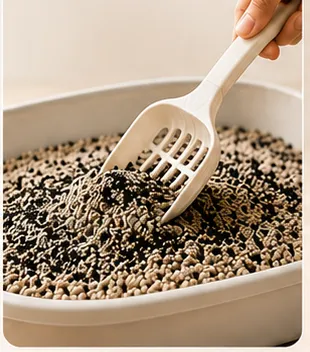
“Changing the litter” covers two things that happen on completely different schedules: lifting out waste, and emptying the tray. Mixing them up is why advice on this varies so wildly.
Scooping: at least once a day
Every day, ideally twice. This is not about tidiness — it is about removing urine before bacteria have finished converting it to ammonia, which takes hours rather than days.
Morning and evening is the pattern that works for most households. If you can only manage one, make it consistent rather than whenever you remember.
Full changes: depends on the litter
A full change means emptying everything, washing the tray and refilling.
| Litter type | One cat | Two cats sharing |
|---|---|---|
| Clumping clay | every 2–4 weeks | every 1–2 weeks |
| Non-clumping clay | twice a week | every 2–3 days |
| Silica crystal | every 4 weeks | every 2 weeks |
| Wood pellet | every 2–4 weeks | every 1–2 weeks |
| Paper | weekly | twice a week |
Clumping clay is the common case. Because urine forms liftable clumps, the remaining litter stays usable for a long time — provided you top up to keep the depth at 7–10 cm as you remove clumps.
Non-clumping clay absorbs urine into the whole bed rather than isolating it, so the tray degrades quickly no matter how diligently you scoop solids. This is the type that most needs frequent full changes.
Silica crystal absorbs moisture and lets it evaporate, holding out longer than anything else, but it does nothing about solids — those still come out daily. When the crystals stop looking translucent and the tray starts to smell, they are saturated.
Wood pellet breaks down into sawdust as it absorbs. Many owners sift the sawdust out and top up with fresh pellets, which stretches the interval considerably.
Paper is the most absorbent by weight and the fastest to become sodden.
The signals that override the schedule
Change it early, whatever the table says, if:
- it smells when you walk into the room, having just been scooped
- the litter looks grey or darkened rather than its original colour
- clumps are breaking apart when you lift them — the clumping agent is spent
- there is damp litter stuck to the base of the tray
- your cat has started hesitating at the tray, scratching at the edge rather than in the litter, or going elsewhere
That last one is the important one. Cats are fastidious, and tray avoidance is very often a cleanliness complaint before it is anything else.
Topping up is not changing
Adding fresh litter on top of old litter resets the depth but not the bacterial load underneath. It is the right thing to do between full changes — necessary, in fact, as scooping removes volume — but it does not extend the interval indefinitely. Keep the schedule.
Making the interval longer
Besides depth and scooping frequency, the main thing that extends the usable life of a tray of litter is keeping odour from establishing in the first place. Activated carbon mixed in at the start adsorbs odour compounds as they are produced, which is why it tends to push the full change further out rather than just masking the point at which you would have changed it anyway.
It does not make a saturated tray clean. Nothing does except emptying it.