
Litter tray smell in a small flat
The usual advice assumes a utility room. Here is what to do when the tray has to live in the bathroom or the hall.
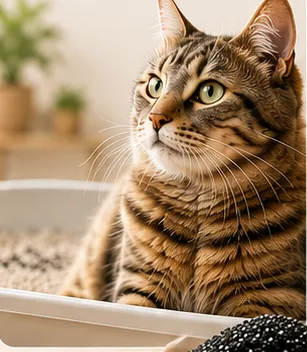
Litter odour is a volume problem as much as a chemistry one. The same tray that goes unnoticed in a house with a utility room becomes the defining smell of a one-bedroom flat, because the same quantity of ammonia is distributed through a fraction of the air.
Nothing about the cat has changed. What has changed is that every mitigation now matters more.
Placement, when you have almost no choice
The constraints are real: it cannot go near food bowls, it cannot go anywhere the cat feels trapped or startled, and in a studio there may be three candidate spots in total.
Ranked roughly by how well they tend to work:
- Bathroom, with the extractor fan. The fan is the asset. If it runs on a timer with the light, you have mechanical ventilation at exactly the tray. Keep the tray away from the shower so it does not get damp — wet litter smells far worse and clumps badly.
- Hallway, away from the front door. Usually has some through-draught, and nobody lingers there.
- Under a window that opens. Even a trickle vent helps.
- Bedroom. Last resort. Ammonia at head height for eight hours is unpleasant and, at the concentrations a neglected tray can reach in a small room, genuinely irritating to airways.
Avoid cupboards, boxed-in “hidden” furniture and the inside of wardrobes entirely. Concealment traps the gas and releases it in a slug when you open the door. It solves the look of the problem and worsens the smell of it.
Ventilation beats everything else here
In a small space, air exchange does more than any product. A window open 2 cm on a vent latch, or an extractor run for twenty minutes after scooping, moves more odour out than any amount of absorbent.
This is also why hooded trays tend to disappoint in flats. They do not remove anything; they delay it and concentrate it.
Scooping frequency is not optional in a flat
Twice a day. In a house you can get away with once; in a studio the margin does not exist. If you are out for long days, scooping before you leave and immediately when you get back is the single most effective change you can make.
Choose a low-dust, low-tracking litter
Two reasons this matters more in a small home. Dust from clay litter stays suspended in a small room for longer and settles over everything within a couple of metres. And litter tracked out of the tray carries urine residue onto the floor, where it smells independently of the tray.
A covered-entry or high-sided tray with a mat in front deals with most tracking. Note that a high-sided tray is not the same as a hooded one — it keeps litter in without sealing the air.
What to add, and what not to
Activated carbon in the litter is well suited to small spaces precisely because it removes odour rather than relocating or masking it. It is unscented, which matters when the tray is three metres from where you sleep.
Plug-in air fresheners are the wrong answer in a small flat. You are adding a continuous fragrance to a small volume of air, on top of the smell you are trying to remove, and some cats react badly to them. Reed diffusers and scented candles have the same problem.
A standalone HEPA-and-carbon air purifier does help if you already have one, but as a purchase it is an expensive way to solve a problem that an open window and a scoop solve first.
If you are considering a different tray
Self-cleaning trays genuinely reduce odour, because they remove waste within minutes rather than hours. They are expensive, they need mains power near the tray, and some cats will not use them. If the budget exists and your cat accepts it, it addresses the root cause — time — better than any additive.
Otherwise: scoop, ventilate, no fragrance, and carbon for the gap between scoops.